

What Does The Clean And Jerk Work
Few moves are as dynamic and recruit as many muscles — namely, the quads, back shoulders, glutes, and core — every bit the clean and jerk. Information technology's one of the two competition lifts in the sport of weightlifting, but information technology'southward a pretty useful addition to your conditioning program. That said, the clean and jerk isn't easy to practice. Information technology's essentially three moves in one — a deadlift, a clean, and an overhead press — and learning it takes time, skill, and patience. Notwithstanding, you'll exist rewarded with more full-body strength, coordination, and power — which is probably why y'all're reading this commodity.
In this guide, we'll go over all of the steps needed to perform a proper clean and jerk, too as the move's benefits, variations, and alternatives.
- How to Do the Clean and Jerk
- Benefits of the Clean and Jerk
- Muscles Worked by the Clean and Wiggle
- Who Should Exercise the Clean and Wiggle
- Clean and Jerk Sets, Reps, and Weight Recommendations
- Make clean and Wiggle Variations
- Clean and Jerk Alternatives
- Frequently Asked Questions
Editor'southward note: The content on BarBend is meant to exist informative in nature, merely it shouldn't accept the place of advice and/or supervision from a medical professional. The opinions and manufactures on this site are not intended for use as diagnosis, prevention, and/or handling of health issues. Speak with your physician if you lot accept any concerns.
How to Exercise the Clean and Wiggle
Below is a pace-by-step guide on how to perform the clean and jerk with a barbell. (Annotation: You lot can near certainly practise a clean and jerk with a set of dumbells or a pair of kettlebells. It's traditionally done with a barbell, so that's the variation we're outlining below.)
Step ane — Get Set
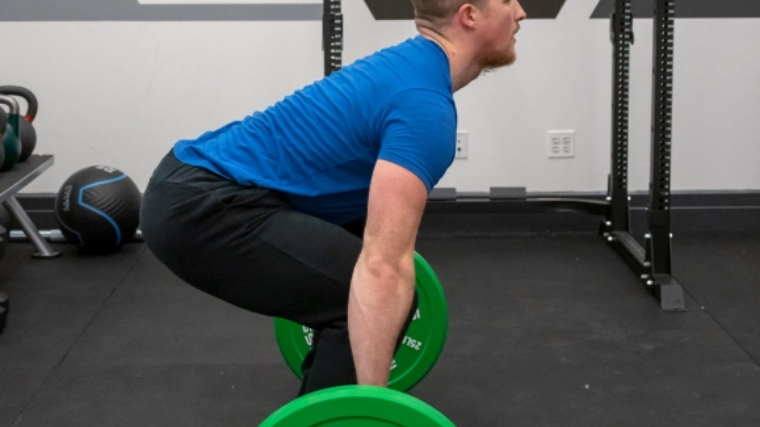
Stand in front of a loaded barbell with the feet prepare hip-width and turned slightly out (as this will allow the lifter to keep the knees/thighs out on the setup). The shoulders should cover the barbell, with the hips lower than shoulder-level all the same higher than the knees. Note: these are full general setup concepts, and specific setups may vary based on motorbus/athlete preferences.
Form Tip: The barbell should be in contact with the shins at the setup. This volition ensure the barbell starts close to the body in the pull, which ensures a smooth bar path.
Step 2 — Initiate the First Pull
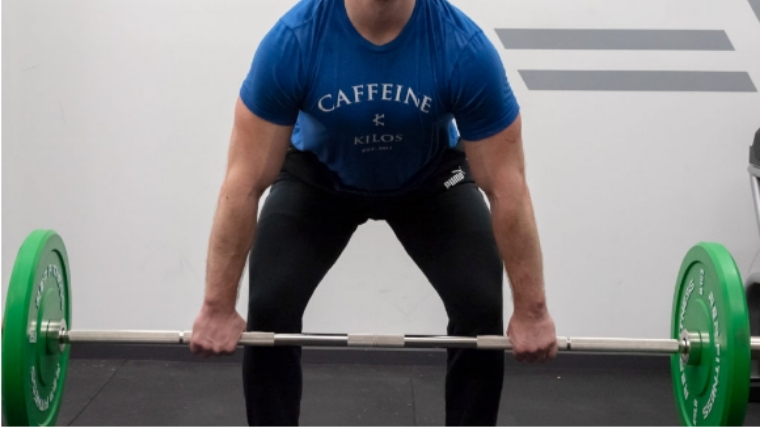
The starting time pull of the clean occurs when the barbell initially breaks from the flooring. The start pull ends when the barbell passes the genu, which is the beginning of the second pull. The initial pull is essentially a deadlift. Be certain to maintain a neutral spine and to keep your core braced.
Form Tip: The goal of this first pull is to gain the momentum necessary for an explosive second pull.
Pace three — Initiate Second Pull and Turn the Bar Over
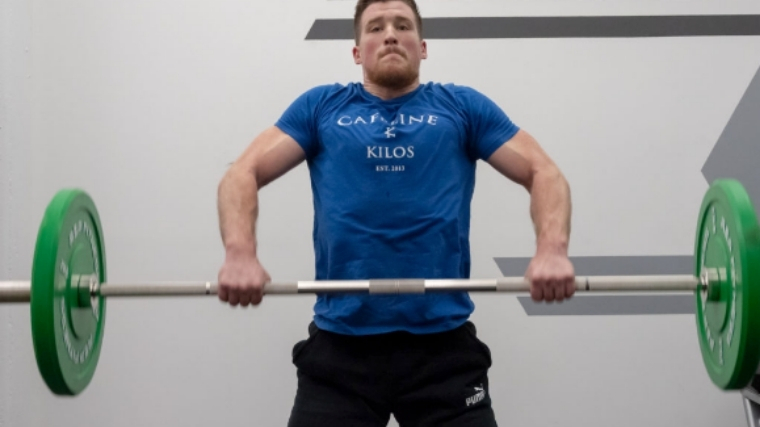
This next step could be broken down into two parts, but information technology happens so rapidly that it's basically i cohesive footstep. For this pull, the barbell passes the knee joint and ends up right at hip level. The lifter then drives their hips and pulls the barbell up the body, making sure to stay balanced in the total human foot with the shoulders in a higher place the bar. And so, the lifter acts upon the barbell to forcefully rotate their elbows underneath and into the forepart rack position. As yous finish the second pull, stay agile on the barbell after the second pull using the traps to elevate the bar higher and pull oneself under the bar.
Form Tip: Try to simultaneously motion the feet and reset them firmly under your hips then that you're in a strong front rack position.
Step 4 — Catch the Barbell
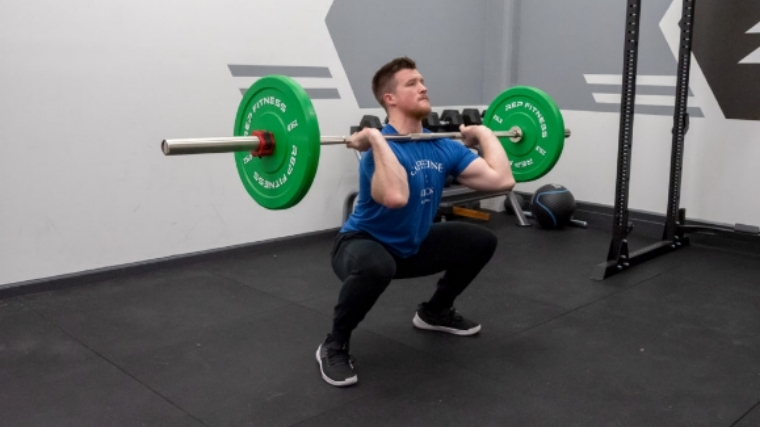
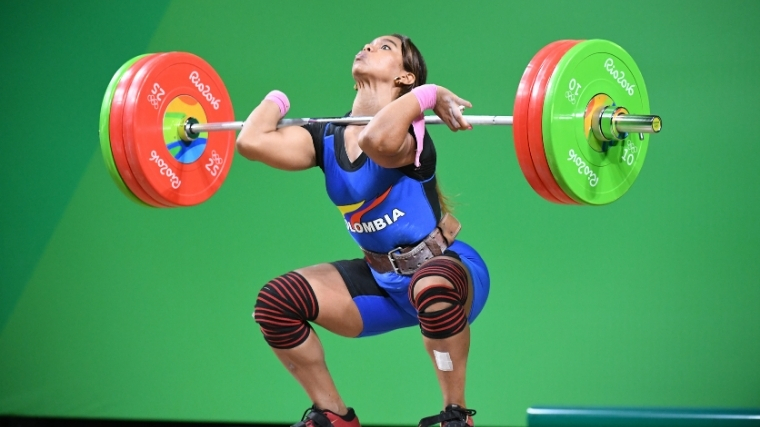
As the bar is exploding up from the hip drive, the lifter will quickly squat down and catch the barbell across their shoulders in a front rack position. The elbows should exist pointing forward.
Form Tip: Be enlightened of your knees. A lot is going on during a clean and wiggle, so exist sure to keep your knees actively pressed out for an efficient squat.
Step 5 — Dip Down
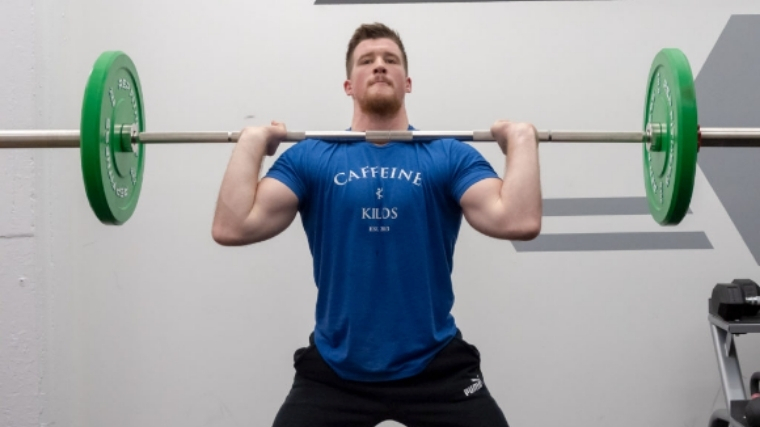
From the front rack position, the lifter is going to dip their knees down a few inches. This creates a jump-like result to help drive the weight overhead for the jerk stage of the lift. This phase of the lift is essentially a push button press.
Form Tip: The dip speed should be smooth and let for a stretch reflex to take place. Be certain to dip downwards in a direct line, not letting the torso sway back or come forwards.
Pace 6 — Jerk the Bar Overhead
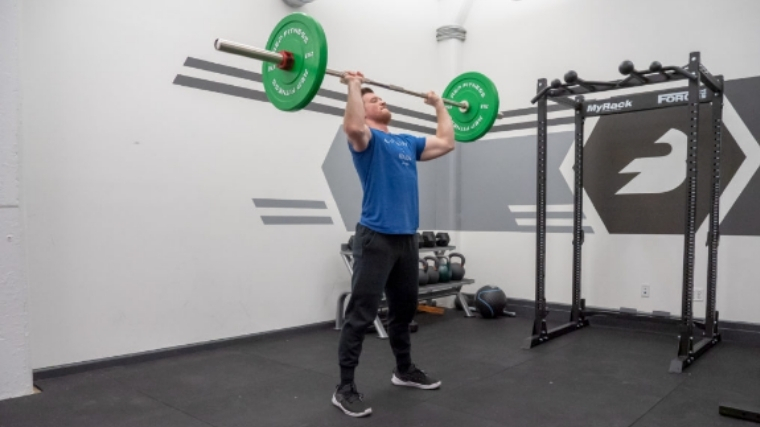
In that location are two types of jerk — a split up jerk and a squat jerk. For now, we'll stick with the squat jerk. Don't call up of the wiggle as only an overhead press. Really, it's a push button printing that your drib under to reduce the distance it has to travel overhead. So, yous're going to a) dip down, b) drive the bar over your head, and c) drop into a half squat position every bit the bar ascends.
Form Tip: Initiate the drive with the legs, and recall well-nigh pushing everything y'all can through the bar.
Step 7 — Receive and Recover the Jerk Overhead
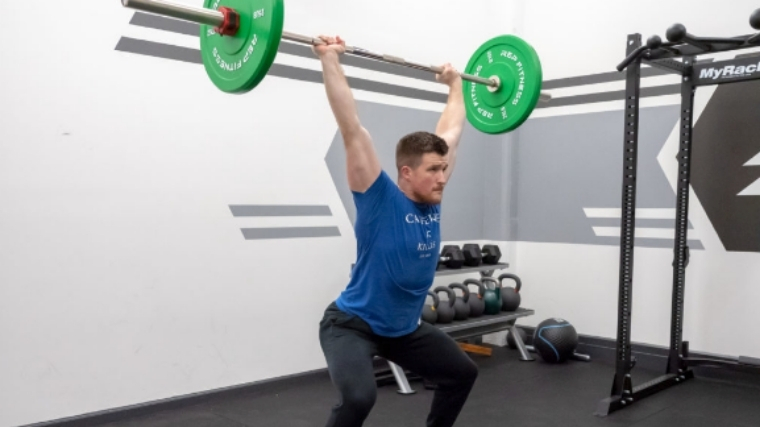
Lock your arms out and pause in the lesser of the jerk to stabilize the weight. Hold this position while you get set. Practise not stand upward until the weight feels balanced. Once you lot're stabilized, stand up.
Form Tip: If you feel as though you're going to drop the weight, keep your arms locked out and let them fall forrard so that the bar crashes to the floor. Don't lean forward, as the bar may bounce back and hit your head.
Benefits of the Clean and Jerk
There are many benefits of the clean and jerk. Hither are three main ones that make the clean and jerk a worthwhile addition to your workout split.
Full Body Strength and Ability
You have to be strong and explosive at every stage of the lift — from the pull off the ground to the hip drive to the jerk. Each muscle will exist taxed and activated during the clean and jerk, which is why it's considered i of the best full-body moves y'all can do for more strength and power. Just as focusing on the deadlift, push button press, and clean will bear over to a stronger accommodating clean and jerk, doing clean and jerks will strengthen those individual moves.
Improved Athletic Performance
There'south a reason why athletes teams outside of weightlifting perform the clean and wiggle (and its many variations). The strength that it develops in the glutes and legs results in the power to dart faster and jump higher. One meta-analysis in the British Periodical of Sports Medicine concluded that Olympic weightlifting movements upshot in an improved vertical jump. (ane)
Meliorate Motor Skill Development
The clean and jerk is a technically complicated movement that requires the lifter to focus on many aspects at once. To make this exercise — or whatsoever do — happen, the central nervous system sends signals to the muscles to direct them. This connection between your brain and your muscles is also chosen "motor skill." Like a muscle, the CNS can be trained to be more efficient and responsive. The more you do the motility, the more expert you'll exist at information technology.
Muscles Worked by the Clean and Jerk
The clean and jerk is a full body movement that stresses well-nigh every musculus in the trunk. Beneath are the major muscle groups that are worked when performing the clean and jerk practise.
Hamstrings
The hamstrings are actually only involved in the hip-drive, or 2nd pull, phase of the clean and jerk. They're contracted explosively and for a short time, and so the clean and wiggle isn't the best exercise to grow your hammies. Y'all'll desire to besides add the Romanian deadlift and practiced morning to your routine for optimal hamstring development.
Quadriceps
The quadriceps are used in the squatting aspect of the clean and the dip and drive stage of the jerk. Strong quads help increase one's ability to get out of the clean.
Back and Traps
The back (lats) and traps are all used during the pulling, squatting, andjerk phase of the lift. A stiff back and traps are needed to maintain an upright position in the forepart squat and offer stability in the jerk.
Shoulders
The shoulders, along with some of the supporting muscles of the arms (triceps and biceps), are near active during the jerk. Though the jerk motility comes mainly from leg bulldoze, the shoulders are working isometrically to stabilize the weight overhead. So, yous'll however desire to add different shoulder exercises into your routine to develop them fully.
Who Should Do the Clean and Jerk?
Below we volition talk over what types of athletes tin benefit from the clean and jerk and why.
Strength and Ability Athletes
Strength and power athletes use the bench press to increase overall strength, add together quality musculus mass to the breast and triceps, and improve sport-specific performance.
- Powerlifters and Strongmen/Strongwomen : Pure forcefulness athletes can integrate the clean and wiggle into their training to ameliorate ability output and overall athleticism.
- Weightlifter s: The make clean and jerk is a necessary exercise for all Olympic weightlifters to train as it is one of the ii movements performed in a competition. Practicing this motion and its various positional drills can increase technique and overall operation in competition.
Functional Fettle Athletes
The clean and jerk is a movement that is often constitute in CrossFit programs, competitions, and workouts (in some form). CrossFit and fettle athletes should use the make clean and jerk to improve overall force , power and train it to utilize in contest.
General Population
Everyday gym-goers can reap the same benefits mentioned above by using the clean and jerk. That said, it'southward a technical motility that, if not done properly, can lead to potential injury risk. So, be sure to consult a trainer for guidance and ever use a lighter weight than you think you tin handle.
Clean and Wiggle Squat Sets, Reps, and Weight Recommendations
Below are iii sets, reps, and weight (intensity) recommendations for coaches and athletes to properly plan the clean and jerk based on training goal. Note that the below guidelines are hither to offering coaches and athletes loose recommendations for programming. While the make clean and jerk can assist spark muscle growth, information technology's not a move you should program for hypertrophy purposes.
To Improve Technique
The make clean and wiggle should be trained with light to moderate loads to develop proper positional awareness, timing, and foundational movement patterning necessary for more advanced training progressions. Start past performing three to five sets of three to five repetitions with light to moderate loads or 50-65% of your one-rep max. The key hither is move quality, timing, and precision.
To Increase Power Output
This phase is ofttimes used for athletes (non-Olympic weightlifter, see next section) looking to integrate the make clean and jerk to ameliorate athletic ability outputs. Stick with iii to five sets of two to five reps using 60-eighty% of your 1RM.
To Meliorate Olympic Weightlifting Performance (Non-Peaking)
This is the training range that well-nigh Olympic weightlifters will spend most of their training career in, as it can be manipulated to increase book, add together intensity, and accost maximal power output. More often than not speaking, nearly Olympic weightlifter will perform 3 to 10 sets of 1 to three reps with around 70-75% of their 1RM.
Clean and Jerk Variations
Below are three mutual clean and jerk variations to build strength, address technique issues, and better Olympic weightlifting performance.
Cake Make clean
The block clean can be done to increase the rate of strength production in the clean or address technical breakdowns in the pull. The block clean is done from blocks, ready at varying heights to assistance improve positional strength. These are also great additions to use before a cake make clean, such every bit in a complex (see beneath).
Clean + Jerk Complex
Weightlifting complexes are a combination of different phases of an Olympic lift strung together. This flow of movements increases training volume, adds variety to training, and reinforces proper technique and positional strength. For example, in the video below, the lifter performs a clean, then a front squat, so two jerk variations. He notwithstanding did a full clean and jerk but broken down into separate lifts. Yous can try that complex below or get-go with something more uncomplicated. Even a full clean with an additional forepart squat is an added challenge.
Hang Make clean
The hang clean is like to the block make clean in that it increases force production in the make clean. This is also a good variation to incorporate with lifters who have issues transitioning under the bar. You can perform these from varying hang heights, such as below the knee (depression hang) above the human knee.
Clean and Jerk Alternatives
Beneath are three clean and jerk alternatives that can be used to improve power outputs with an easier learning curve.
Clean/Snatch High Pull
The clean/snatch loftier pull may decrease injury risks of the wrists or minimize the technical coaching needed to assist lifters. This can aid not-weightlifting athletes looking to get the benefits of power preparation without running risks of injury due to lack of proper readiness.
Make clean and Press
The clean and pres south is similar to the clean and wiggle. Even so, the athlete can perform a strict pres to get the weight overhead. This is a good option for lifters who lack proper wiggle timing and technique. This is as well skilful for adding overhead forcefulness, as the wiggle requires less concentric force as strict pressing or push pressing loads overhead.
Brawl Clean
The ball clean has the lifter perform the movement with a medicine ball. It'due south a great way to teach the exercise and for younger or older lifters who may lack the skills for the barbell version.
FAQs
How should I larn the clean and jerk?
Ideally, yous'll find a local qualified coach (USA Weightlifting Accredited) in y'all area to get some initial coaching from. I f you cannot do this, opt to look for a good coach online who will interruption down the lift and have you begin with the basics like movements.
I'm weak out of the hole of my forepart squat, how can I fix this?
Increasing leg strength for the clean and jerk is non as unproblematic equally doing more cleans. In addition to increasing the volume of front squats you do, be certain to treat the front squat portion of the clean every bit a separate lift. This means take a 2nd to get prepare, lower yourself slowly, and drive up with expert form. Don't rush through the movement like it'due south simply a step in the clean and jerk. Information technology is, but 1 that should exist handled with intendance.
How often should I do the clean and wiggle?
Most lifters looking to improve weightlifting performance and technique should aim for at least three training sessions per week that include the clean and wiggle or variations. The more than frequently yous train information technology, you need to make sure y'all are likewise monitoring recovery, grooming intensity, and functioning over fourth dimension to detect what works best for you lot.
References
Featured image: A.RICARDO/Shutterstock

Source: https://barbend.com/clean-and-jerk/
Posted by: traviswitheirate.blogspot.com
0 Response to "What Does The Clean And Jerk Work"
Post a Comment